
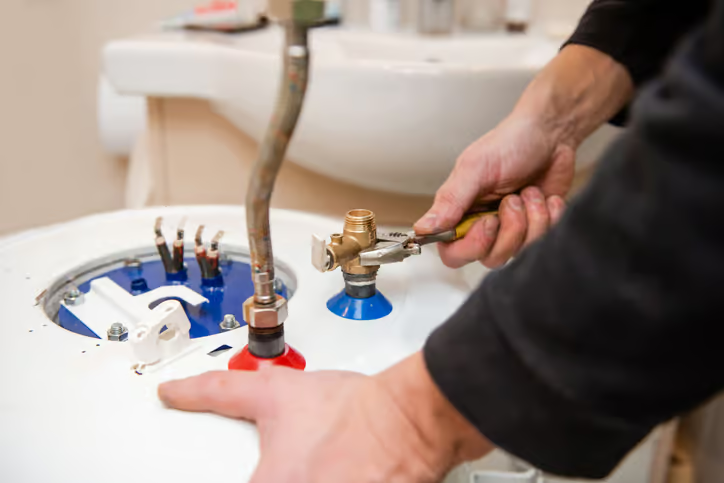
The repair-vs-replace decision is rarely obvious
Most water heater decisions come down to a question: repair the existing unit or replace it? The honest answer is rarely “always replace” or “always repair.” It depends on the unit’s age relative to expected service life, the type of failure (some are repairable, some aren’t), the relative cost of repair vs. replacement, current efficiency considerations, capacity changes since installation, and the opportunity for type upgrades (tank to tankless, electric to gas). A unit that’s six years old with a faulty thermostat is a clear repair candidate. A unit that’s twelve years old with a leaking tank body is a clear replacement candidate. The challenging decisions sit in the middle – the eight-year-old unit with multiple developing issues, the ten-year-old unit that still works but is increasingly inefficient.
This guide provides a decision-making framework for homeowners facing the repair-or-replace question. It covers the six factors that should drive the decision (age vs. service life, type of failure, the 50% rule for repair-vs-replace economics, efficiency math, capacity changes, type-change opportunity), the eight symptoms that indicate replacement is approaching (giving you early warning before sudden failure), the DFW-specific considerations that affect water heater service life (NTMWD water hardness, attic installation cost considerations, February 2021 freeze legacy), the cost-benefit math of repair vs. replacement, and 2026 DFW market pricing across the full water heater replacement spectrum. The objective is informed decision-making rather than reactive emergency replacement.
For active water heater problems and diagnostic guidance, see our common water heater problems guide. For active emergencies (leaking water heater requiring immediate response), see our plumbing emergencies guide. This guide focuses on the proactive decision-making layer – knowing when replacement is coming and choosing replacement rather than waiting for catastrophic failure.
Key takeaways
- Tank body leaks always require replacement, never repair. Once the tank itself has failed structurally, the unit is at end of life. Replacement is the only safe response.
- Expected service life varies by type: gas tank water heaters typically 8-12 years, electric tank heaters 10-15 years, tankless heaters 15-20 years. Units past expected life should be replaced proactively rather than waiting for failure.
- The 50% rule: if repair cost exceeds 50% of replacement cost, replacement is typically the better economic decision. Repairs in the final years of service life rarely pay back fully.
- Efficiency math favors replacement for older units. Modern water heaters are dramatically more efficient than 10-year-old units. The energy savings can offset significant portion of replacement cost over the new unit’s service life.
- Eight early-warning symptoms typically appear before catastrophic failure: discolored water, sediment noise, insufficient hot water duration, slow recovery times, T&P valve repeatedly discharging, visible corrosion at base or top fittings, rising hot water bills without usage change, multiple recent repairs.
- DFW-specific considerations affect water heater service life: NTMWD 8-12 grain water hardness accelerates sediment accumulation in tank heaters; attic installations have dramatically higher catastrophic failure costs from water damage; February 2021 freeze damage continues to surface in 2026.
- Replacement is an opportunity for type upgrade: tank to tankless (smaller footprint, no standby losses, longer service life), electric to gas (if gas available, faster recovery and lower operating cost), or like-for-like with newer efficiency standards.
- Call 214-918-6109 for water heater replacement assessment, replacement installation, and ongoing maintenance across Mesquite, Garland, Rowlett, Dallas, Plano, Richardson, Balch Springs, and Sunnyvale – Master Plumber License M-39428 with gas endorsement.
The 6-factor decision framework
Factor 1: Age vs. expected service life
Water heater type determines expected service life:
- Tank gas water heaters: 8-12 years typical service life. Some last longer with excellent maintenance and quality water; some fail earlier in high-hardness water areas like DFW.
- Tank electric water heaters: 10-15 years typical service life. No combustion stress; generally longer life than gas if not affected by sediment.
- Tankless water heaters (gas or electric): 15-20 years typical service life with proper maintenance. Smaller heat exchangers but no tank corrosion failure mode.
- Heat pump water heaters: 10-15 years typical service life. Newer technology in residential applications.
Decision implication: units past expected service life should be replaced proactively rather than waiting for failure. The cost of proactive replacement during normal hours is dramatically less than the cost of emergency replacement after a catastrophic failure (often with associated water damage).
Factor 2: Type of failure
Some failures are repairable; others require replacement:
Always replace (structural failures)
- Tank body leaks: water seeping or flowing from the tank itself. The internal glass lining has failed; the steel tank is corroding. Cannot be patched reliably; replacement is the only safe response.
- Severe corrosion at base or top fittings: indicates structural deterioration approaching tank failure
- Multiple component failures simultaneously: when more than one major component fails near end of expected service life, full replacement makes more sense than serial repairs
Repair vs. replace decision (component failures)
- Thermostat failure: $100-$300 repair; almost always worth fixing if unit is not past service life
- Heating element failure (electric): $200-$500 repair; worth fixing in first half of service life, often not worth fixing past 10 years
- Gas valve failure: $300-$700 repair; worth fixing in first half of service life, often not worth fixing past 8 years
- T&P valve failure: $200-$400 repair; always worth fixing regardless of unit age (safety device)
- Drain valve failure: $200-$400 repair; worth fixing
- Flue/venting issues: variable; depends on scope and unit age
Always repair (safety devices)
- T&P valve discharge: must always be addressed (cause investigated and corrected). Never bypass.
- Combustion safety concerns: must always be addressed before continued operation
Factor 3: The 50% rule for economic decisions
A common rule of thumb in the water heater industry: if repair cost exceeds 50% of replacement cost, replacement is typically the better economic decision. The reasoning: spending substantial money on a unit late in its service life doesn’t extend life significantly; the saved repair cost can be applied toward replacement that has fresh service life and warranty.
Example calculations:
- 9-year-old gas tank water heater with failed gas valve. Repair: $500. Replacement: $1,800. Repair = 28% of replacement. Decision: lean toward repair if budget supports it, but flag that you’re in the back half of expected service life.
- 11-year-old gas tank water heater with failed gas valve. Repair: $500. Replacement: $1,800. Same dollar amounts, but unit is past expected service life. Decision: lean toward replacement; the $500 may be wasted if unit fails for other reasons within 1-2 years.
- 10-year-old electric tank water heater with both heating elements failing. Repair: $700. Replacement: $1,500. Repair = 47% of replacement. Decision: marginal; combination of approaching service life end and high repair cost makes replacement reasonable.
The 50% rule is a guideline, not a strict rule. Other factors (efficiency, capacity, type upgrade opportunity) may shift the decision toward replacement even when repair cost is below 50%.
Factor 4: Efficiency math
Modern water heaters are dramatically more efficient than units from 10-15 years ago. Federal efficiency standards have tightened multiple times during the typical residential water heater service life. Replacing an old unit with new captures significant efficiency improvement.
Typical efficiency improvements
- Gas tank water heater: 10-year-old standard efficiency unit vs. current high-efficiency: 15-25% energy reduction
- Electric tank water heater: 10-year-old vs. current ENERGY STAR: 10-20% energy reduction
- Tank to tankless conversion (gas): 20-35% energy reduction (eliminates standby losses)
- Tank to heat pump water heater (electric): 50-70% energy reduction (heat pump efficiency advantage)
What this means in dollars
For a typical DFW household using 60-80 gallons hot water per day: $600-$1,200 annual water heating cost with standard 10-year-old gas tank. 20% efficiency improvement = $120-$240 annual savings. Over 10 years of new unit service life: $1,200-$2,400 cumulative savings. This savings can offset significant portion of replacement cost.
Tankless efficiency considerations
Tankless units have higher upfront cost but lower operating cost. The math depends on hot water usage patterns:
- Low usage households (singles, retirees): tankless payback is long; tank is often more economical
- Standard family use: tankless payback in 5-8 years; total ownership cost favors tankless
- High use households (large families, multiple bathrooms): tankless payback in 3-5 years; significant lifetime savings
Factor 5: Capacity changes since installation
Family size and usage patterns change over years. Water heater capacity that was adequate at installation may be inadequate now:
- Family size growth: from couple to family with children dramatically increases hot water demand
- Added bathrooms: each added bathroom adds 10-20 gallon daily demand
- Added high-demand fixtures: jacuzzi tubs, multi-head showers, washing machines
- Aging in place: longer showers, more frequent hot water use
If the existing unit is undersized for current demand, replacement with appropriate capacity unit solves multiple issues simultaneously. Common upgrades:
- 40-gallon to 50-gallon tank: $200-$400 additional cost for substantially more capacity
- 50-gallon to 75-gallon tank: $400-$800 additional cost
- Tank to tankless: unlimited hot water duration (sized appropriately for fixture demand)
Factor 6: Type-change opportunity
Replacement is an opportunity to upgrade type, not just replace like-for-like:
Tank to tankless
- Pros: smaller footprint (reclaim closet/utility space), no standby losses, longer service life (15-20 years), unlimited hot water duration with proper sizing
- Cons: higher upfront cost, may require gas line upsizing for gas tankless, may require electrical upgrade for electric tankless, more complex installation
- Best fit: families with high hot water demand, homeowners planning long-term residence, situations where small footprint matters
Electric to gas (where gas is available)
- Pros: faster recovery time, lower operating cost (in most markets), better performance during cold weather
- Cons: requires gas line installation if not present, requires venting, more complex installation
- Best fit: homes with available gas supply but electric water heater installed, situations where recovery time matters
Standard to high-efficiency or condensing
- Pros: significantly better efficiency, potential rebates or tax credits, longer warranty in many cases
- Cons: higher upfront cost, may require venting changes for condensing units
- Best fit: homeowners prioritizing long-term operating cost, situations where higher efficiency offsets upfront cost over expected ownership
Standard electric to heat pump water heater
- Pros: dramatically improved efficiency (50-70% energy reduction), potential rebates and tax credits, longer-term technology
- Cons: higher upfront cost, requires adequate space and ventilation for heat pump operation, longer recovery in cold spaces
- Best fit: situations with adequate installation space, homeowners prioritizing long-term efficiency
The 8 early-warning symptoms (replacement is approaching)
1. Discolored hot water
Hot water that comes out rusty, brown, or yellow indicates tank interior deterioration. The glass lining inside the tank has begun failing; the exposed steel is corroding. The unit may have months to a year of service before tank body failure. Discolored water doesn’t require immediate replacement but is a clear signal that replacement should be planned. Cold water from the same faucet running clear (as it usually does) confirms the issue is in the water heater, not the supply line.
2. Sediment noise (rumbling, popping, sizzling)
Unusual sounds from the water heater indicate substantial sediment accumulation. Hard water (like NTMWD 8-12 grain DFW supply) builds sediment over years; the buildup creates pockets where water is heated under the deposits, producing the sounds. Sediment doesn’t immediately cause failure but reduces efficiency, increases stress on heating elements (electric) or burner (gas), and accelerates tank deterioration. Annual flushing helps; once sounds are significant, replacement may be approaching.
3. Insufficient hot water duration
The water heater that used to provide 25 minutes of hot shower now provides 15. The same family activities now use up all available hot water before everyone has bathed. Capacity hasn’t actually decreased – sediment buildup has reduced effective volume by accumulating in the bottom of the tank. As sediment grows, available hot water decreases. Significant sediment-related capacity reduction typically appears in years 8-12 for tank water heaters in DFW.
4. Slow recovery times
The water heater that used to refill with hot water in 30 minutes now takes 60. Sediment insulates the burner (gas) or heating element (electric) from the water, reducing heat transfer efficiency. Recovery times stretch; the wait between hot water uses extends. Like duration reduction, slow recovery indicates substantial sediment and approaching end of life.
5. T&P valve repeatedly discharging
The temperature and pressure relief valve is a critical safety device that opens to release pressure when tank conditions exceed safe limits. Repeated discharge indicates: temperature or pressure issues with the tank, valve approaching failure, or unit condition that’s stressing the safety system. T&P valve discharge requires investigation and correction; persistent discharge is a clear signal that replacement should be evaluated.
6. Visible corrosion at base or top fittings
Rust streaks running down the side of the tank from connection points, visible corrosion at the base where the tank meets the floor, rust on supply line connections at the top of the tank – these indicate tank deterioration. The visible corrosion is the late stage of internal corrosion progressing; structural tank failure may follow within months.
7. Rising hot water bills without usage change
Energy bills have crept up over years without changes in household hot water usage. The aging water heater is becoming less efficient as sediment builds, heating elements lose efficiency, and component performance degrades. The energy cost increase represents real money – and indicates the unit is approaching the point where replacement makes economic sense.
8. Multiple recent repairs
The water heater that needed thermostat replacement last year, gas valve replacement this year, and now has an issue with the heating element/burner is sending a clear message. Components are reaching end of life serially. Each repair extends service slightly but doesn’t address the underlying age-related deterioration. After two significant repairs on an aging unit, replacement typically makes more sense than a third.
DFW-specific considerations
NTMWD water hardness impact
North Texas Municipal Water District water typically runs 8-12 grain hardness with chloramine disinfection. The hardness accelerates sediment accumulation in tank water heaters dramatically compared to softer water markets. DFW tank water heater service life is often shorter than national averages – 6-10 years gas, 8-12 years electric in DFW vs. 8-12 / 10-15 in softer water markets.
Mitigation: annual flushing significantly extends service life. Water softeners reduce sediment accumulation. Tankless water heaters with regular maintenance avoid the tank sediment failure mode entirely.
Attic installation cost considerations
Many DFW homes have water heaters installed in attics due to slab foundation considerations. Attic installation creates dramatically different failure cost economics:
- Routine failure (no leak): standard replacement cost
- Failure with leak: catastrophic. Water flows from attic through ceiling, ruins ceiling drywall, damages framing, soaks insulation, destroys flooring on the floor below, often damages contents
- Property damage from attic water heater failure: often $10,000-$40,000+ in restoration costs
The failure cost calculus favors proactive replacement for attic-installed units. Replacing an attic water heater at year 10-11 costs the same as replacing one at year 13-14, but the failure-during-the-extra-years scenario is catastrophic. Drip pans with leak sensors connected to automatic shutoff valves are essential for attic installations; their cost ($300-$1,500) is trivial compared to potential failure damage.
February 2021 freeze legacy
The February 2021 freeze damaged water heaters across DFW. Some failed immediately during the event; others were damaged but continued operating with degraded performance. The damaged units have been failing progressively in 2022-2025, with continued failures expected through 2026. Homes with 2021-affected water heaters that haven’t been replaced are running on time borrowed from freeze damage. Proactive assessment is valuable.
Climate considerations for tankless installations
DFW climate is generally favorable for tankless water heaters – mild winters compared to northern markets reduce cold incoming water concerns. However, occasional severe cold events (like 2021) can affect tankless performance. Modern tankless units with proper installation handle DFW climate effectively year-round.
The cost-benefit math
Standard tank replacement
Typical scenario: 10-12 year old tank gas water heater in DFW with multiple developing issues.
- Continue running: gambling on remaining service life. Possible failure within 1-3 years; meanwhile efficiency declines by 1-3% annually.
- Repair: $300-$700 for specific component repair. Doesn’t address other aging components or efficiency.
- Replace with standard efficiency gas tank: $1,200-$2,500 installed. New 12-year service life expectation, current efficiency standards, manufacturer warranty.
- Replace with high-efficiency gas tank: $1,800-$3,200 installed. New 12-year service life, 15-25% efficiency improvement, longer warranty in many cases.
- Replace with gas tankless: $2,500-$5,000 installed. 15-20 year service life, 20-35% efficiency improvement, smaller footprint, unlimited duration with proper sizing.
Decision math for attic installations
For attic-installed units, the calculation shifts:
- Cost of replacement at year 10: $1,500-$3,000
- Cost of failure during year 11-12 (water damage + replacement): $11,500-$43,000
- Risk-adjusted cost analysis strongly favors proactive replacement for attic units
Efficiency payback math
For typical DFW household with 10-year-old tank gas water heater being replaced with high-efficiency tankless:
- Annual energy cost reduction: $150-$300
- Replacement cost premium (vs. standard tank): $1,000-$2,500
- Payback period: 4-10 years
- Lifetime savings (over 15-year tankless service life): $2,250-$4,500 beyond payback
2026 DFW water heater replacement pricing
Tank gas water heaters (most common DFW residential)
- 40-gallon standard efficiency: $1,200-$2,000 installed
- 50-gallon standard efficiency: $1,400-$2,500 installed
- 75-gallon standard efficiency: $2,200-$3,500 installed
- 50-gallon high efficiency: $1,800-$3,200 installed
- Power-vent gas tank (when needed): $1,800-$3,500 installed
Tank electric water heaters
- 40-gallon electric: $1,000-$1,800 installed
- 50-gallon electric: $1,200-$2,200 installed
- 80-gallon electric: $1,800-$3,000 installed
- Heat pump water heater (50-80 gal): $2,500-$5,500 installed
Tankless water heaters
- Gas tankless (interior installation): $2,500-$5,000 installed
- Gas tankless (exterior installation): $2,200-$4,500 installed
- Electric tankless (whole-home): $1,800-$4,000 installed
- Tankless with gas line upsizing: additional $500-$2,000+
Additional cost factors
- Permits and inspections: $100-$400 (typically included in installation quotes)
- Drip pan installation (attic): $300-$700 if not present
- Automatic shutoff valve with leak sensor: $400-$1,500
- T&P drain line installation if missing: $200-$500
- Venting upgrades for high-efficiency models: $300-$1,500
- Electrical upgrades for tankless or heat pump units: $500-$2,500
- Old unit disposal: typically $50-$150 (often included)
What to expect during water heater replacement
Assessment and selection
The plumber assesses current installation, discusses options (like-for-like vs. upgrade), provides written estimate with itemized scope. Duration: 30-60 minutes. Cost: typically free for estimate, may include diagnostic fee if troubleshooting existing unit.
Permit pulling
Required in most DFW jurisdictions for water heater replacement. The plumber handles permitting. Duration: 1-3 business days.
Scheduling
For non-emergency replacement, scheduling typically 1-2 weeks out. Emergency replacement (unit has already failed) can usually be addressed within 24-48 hours.
Installation work
Typical replacement takes 3-6 hours including: shutoff and draining of existing unit, removal of existing unit, installation of new unit, gas/water/electrical connections, venting work if needed, leak testing, initial operation verification.
Inspection
Most DFW jurisdictions inspect water heater replacements. Inspection typically scheduled within 1-3 business days of installation.
Documentation
The plumber provides: permit closure documentation, manufacturer warranty information, workmanship warranty in writing, owner’s manual and operation instructions, recommendations for maintenance schedule.
A 30-year DFW perspective on water heater replacement
The pattern we see most often: water heaters are replaced reactively after failure, often with associated water damage to the home. The 10-year-old unit that was making sediment noises continued running because “it’s still working.” The attic-installed unit with visible corrosion at the base kept operating because replacement was inconvenient. Then the tank failed – usually at the worst possible time – and the homeowner faced both replacement costs and property damage costs.
The opposite pattern – homeowners who replace water heaters proactively before failure – have dramatically better outcomes. Their replacements happen on schedule during normal hours. Property damage is avoided. Modern efficient units begin providing energy savings immediately. The total cost across decades of homeownership is significantly lower despite the appearance of “spending money before you have to.”
The decision framework matters because emotional reasoning leads to bad decisions. “It’s still working” is true until it isn’t. “I’ll save money by waiting” is true for some specific situations and false for most. The systematic approach – age vs. expected life, type of failure, 50% rule, efficiency math, capacity needs, type-change opportunity – leads to better decisions than gut-feel timing.
For 2026 and beyond, the considerations affecting DFW water heater replacement decisions are: continued efficiency improvements making replacement more attractive than 5 years ago; tankless adoption continuing to grow with strong economic case for typical family use; heat pump water heaters becoming more accessible for electric installations; 2021 freeze damage continuing to surface; attic installation costs of failure remaining catastrophic; permitting and inspection requirements stable. The math overwhelmingly favors proactive replacement for units approaching or past expected service life.
When should you call James Armstrong Plumbing?
Call 214-918-6109 for any of the following:
- Water heater approaching or past expected service life (8-12 years tank gas, 10-15 years tank electric, 15-20 years tankless)
- Active water heater problems (see our problems guide for symptoms)
- Early warning symptoms suggesting replacement is approaching
- Repair-vs-replace decision support
- Type upgrade consideration (tank to tankless, electric to gas, standard to high efficiency)
- Attic-installed water heater assessment and proactive replacement planning
- Drip pan and automatic shutoff valve installation
- Capacity assessment for changing household needs
- Post-2021 freeze damage assessment
- Pre-purchase home inspection water heater evaluation
- Pre-sale water heater assessment to address issues before listing
Master Plumber James Armstrong (License M-39428 with gas endorsement, BBB A+ since 2018) and the JAP team provide water heater assessment, replacement, installation, repair, and ongoing service across DFW. For related guides, see our water heater problems guide, water heater services overview, and qualified plumbing contractor selection. Service areas: Mesquite, Garland, Rowlett, Dallas, Plano, Richardson, Balch Springs, and Sunnyvale.
Frequently asked questions
When should I replace my water heater?
Consider replacement when: unit is past expected service life (8-12 years tank gas, 10-15 years tank electric, 15-20 years tankless), tank body is leaking (always replace), repair cost exceeds 50% of replacement cost, multiple early-warning symptoms are present (discolored water, sediment noise, insufficient hot water, slow recovery, rising bills, recent repairs), capacity is no longer adequate for household needs, or efficiency upgrade economics favor replacement. The systematic decision framework leads to better timing than waiting for catastrophic failure.
How long do water heaters last in DFW?
NTMWD water hardness (8-12 grain) shortens tank water heater service life compared to softer water markets. DFW-typical service life: gas tank 8-12 years (often 6-10 in hard water), electric tank 10-15 years (often 8-12), tankless 15-20 years with proper maintenance. Annual flushing extends tank service life. Water softeners reduce sediment accumulation. Tankless units avoid the tank sediment failure mode entirely.
What are the warning signs my water heater needs to be replaced?
Eight early-warning symptoms: discolored hot water (rusty, brown, yellow); sediment noise (rumbling, popping, sizzling); insufficient hot water duration; slow recovery times between uses; T&P valve repeatedly discharging; visible corrosion at base or top fittings; rising hot water bills without usage change; multiple recent repairs. These symptoms typically appear before catastrophic failure, giving homeowners advance notice to plan proactive replacement.
How much does water heater replacement cost in DFW?
2026 DFW pricing: 40-50 gallon standard gas tank $1,200-$2,500 installed; 50-gallon high efficiency $1,800-$3,200; 40-50 gallon electric $1,000-$2,200; heat pump water heater $2,500-$5,500; gas tankless $2,500-$5,000; electric tankless $1,800-$4,000. Additional factors: permits $100-$400, drip pan if not present $300-$700, automatic shutoff valve $400-$1,500, gas line upsizing for tankless $500-$2,000, venting upgrades $300-$1,500. Total project cost varies dramatically based on type, installation complexity, and additional work needed.
Should I repair or replace my water heater?
The 50% rule provides good guidance: if repair cost exceeds 50% of replacement cost, replacement is typically the better economic decision. Other factors also matter: unit age relative to expected service life (past expected life favors replacement), type of failure (tank body leaks always require replacement), efficiency considerations (replacement captures efficiency improvements), capacity adequacy for current needs, and type-change opportunity. Repairing a 10+ year old tank water heater rarely pays back fully; component repairs early in service life almost always pay back.
Should I switch from tank to tankless when replacing my water heater?
Depends on household. Pros of tankless: smaller footprint, no standby losses, longer service life (15-20 years), unlimited hot water duration. Cons: higher upfront cost ($1,000-$2,500 premium), may require gas line upsizing, more complex installation. Best fit: families with high hot water demand, homeowners planning long-term residence, situations where small footprint matters. Less favorable fit: low usage households (singles, retirees), tight installation budgets, homes without gas service for gas tankless. Payback period: 5-8 years for typical family use; 3-5 years for high-use households.
What about heat pump water heaters?
Heat pump water heaters offer dramatic efficiency improvements (50-70% energy reduction vs. standard electric). Installed cost: $2,500-$5,500. Requirements: adequate installation space and ventilation for heat pump operation, electric supply, drain for condensate. Best fit: homes with adequate space, homeowners prioritizing long-term operating cost reduction, situations where federal/state/utility rebates apply. Recovery times can be longer in cold installation spaces; some installations supplement with electric resistance backup. Modern heat pump water heaters with proper installation work effectively in DFW climate.
Are attic water heater installations different?
Yes. Attic installations create dramatically different failure economics. Routine replacement: same cost as floor-level installation. Failure with leak: catastrophic property damage ($10,000-$40,000+) as water flows through ceiling, damages framing, ruins flooring on the floor below, often damages contents. For attic installations, proactive replacement at year 10-11 vs. waiting for failure dramatically favors proactive replacement. Essential equipment: drip pan with leak sensor connected to automatic shutoff valve. These devices cost $400-$1,500 and prevent the catastrophic failure scenario.
How long does water heater replacement take?
Installation work: 3-6 hours for typical replacement, including draining existing unit, removal, installation, connections, leak testing, operation verification. Total timeline from initial call to completion: 1-2 weeks for non-emergency planned replacement (allows permit pulling, scheduling, inspection coordination). Emergency replacement after unit failure: typically 24-48 hours including permit pulling. Permit and inspection process adds 1-3 business days beyond installation.
Do I need a permit to replace my water heater in DFW?
Yes, in nearly all DFW jurisdictions including Mesquite, Garland, Rowlett, Dallas, Plano, Richardson, Balch Springs, and Sunnyvale. The licensed plumber pulls permits as part of their service. Inspection verifies code compliance for: gas connections (if gas), electrical connections (if electric), water connections, venting, T&P valve and drain line, drip pan (if required by jurisdiction). Work performed without permits creates regulatory exposure, insurance issues, and property transaction complications.
This guide reflects 2026 DFW residential water heater replacement decision factors and market pricing. Individual situations vary; for specific repair-vs-replace assessment call 214-918-6109. Manufacturer warranties and federal efficiency standards continue to evolve; current specifications available from manufacturers and product retailers.