
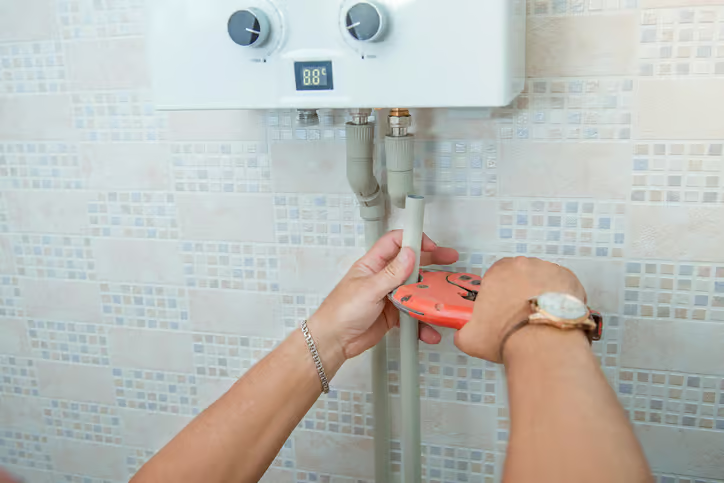
Why tankless maintenance is different from tank maintenance
Tankless water heaters fail differently than tank water heaters. A tank water heater shows clear warning signs over years – sediment noise, rust water, insufficient hot water, slow recovery – giving homeowners time to plan replacement. A tankless water heater typically operates normally until it doesn’t. The failure is more abrupt: an error code appears, hot water stops, or temperature regulation fails suddenly. The mechanisms causing the failure have been developing slowly, but the symptoms surface late.
This makes proactive maintenance especially valuable for tankless units. The maintenance tasks (descaling, inlet filter cleaning, combustion check, venting inspection, error code review) address the developing issues before they cause failure. A tankless unit that receives proper annual maintenance can reach 18-20 year service life; the same unit without maintenance may fail at 8-12 years – same age range as a tank water heater but without the same warning signs. The maintenance investment is small compared to the avoided replacement and failure costs.
This guide focuses specifically on tankless water heater maintenance: why it matters, the 8 annual maintenance tasks, descaling deep-dive (the single most important maintenance task for DFW tankless units), common error codes and their meanings, the DFW-specific factors that make tankless maintenance especially critical (NTMWD water hardness), the maintenance schedule, DIY vs. professional boundaries, 2026 DFW pricing, and the cost-of-neglect math that justifies regular maintenance investment. For tankless general overview (what tankless is, benefits, selection considerations), see our existing tankless water heater content. For tank water heater maintenance and lifespan, see our gas water heater lifespan guide.
Key takeaways
- Tankless water heaters fail abruptly, unlike tank units that show gradual warning signs. Proactive maintenance is the primary way to prevent unexpected failures.
- Descaling is the single most important maintenance task for DFW tankless units. NTMWD water hardness (8-12 grain) creates significant scale accumulation in the heat exchanger; annual descaling is essential.
- Eight annual maintenance tasks: descaling/flushing the heat exchanger, inlet filter cleaning, combustion air verification (gas), venting inspection, error code log review, burner and heat exchanger visual inspection, gas pressure verification, water flow verification.
- Annual maintenance cost: $200-$400 typical. Cost of neglect: $1,500-$5,000 for heat exchanger replacement (when serviceable) or $2,500-$5,000 for full unit replacement.
- Tankless service life with proper maintenance: 18-20 years. Tankless service life without maintenance: often 8-12 years – dramatic reduction.
- DFW-specific factors: NTMWD hard water makes descaling critical (vs. softer water markets where descaling is less urgent); attic installations face thermal stress; February 2021 freeze damaged some tankless units now showing developing issues; chloramine disinfection affects certain components.
- Common error codes: each manufacturer (Rheem, Rinnai, Navien, Noritz, etc.) uses specific error code systems indicating ignition issues, flow problems, scale accumulation, combustion concerns, and other developing issues. Recognizing patterns enables timely intervention.
- DIY vs. professional: inlet filter cleaning is DIY territory; descaling is borderline (requires specific equipment and procedures); combustion analysis and gas system work are professional.
- Call 214-918-6109 for tankless water heater annual maintenance, descaling service, repair, and replacement across Mesquite, Garland, Rowlett, Dallas, Plano, Richardson, Balch Springs, and Sunnyvale – Master Plumber License M-39428 with gas endorsement.
How tankless water heaters fail
Heat exchanger scaling (primary failure mode)
The heat exchanger is the critical component in a tankless water heater – water flows through it while gas burner (or electric element) heats it. Heat exchanger surfaces are designed for efficient heat transfer. When hard water flows through the heat exchanger, minerals precipitate and form scale on the surfaces. The scale:
- Insulates the water from the heat source, reducing efficiency
- Restricts water flow through the heat exchanger
- Creates hot spots that stress heat exchanger metal
- Eventually accumulates enough to cause complete blockage or component failure
DFW’s NTMWD water at 8-12 grain hardness accelerates scaling dramatically compared to softer water markets. Without descaling, DFW tankless units accumulate substantial scale within 12-24 months. After several years without descaling, the heat exchanger may be irreversibly damaged.
Inlet filter blockage
Tankless units have inlet water filters to prevent debris from entering the heat exchanger. Filters accumulate sediment over time. Blocked filters: restrict water flow (reducing capacity), increase pressure on internal components, trigger error codes, eventually cause unit shutdown.
Inlet filter cleaning is one of the simpler maintenance tasks – typically twice yearly is sufficient for DFW conditions.
Combustion issues (gas units)
Gas tankless units have combustion systems that can develop issues: insufficient combustion air supply, burner deterioration, ignition system problems, fan or blower issues, vent obstruction. Combustion problems reduce efficiency, can create safety concerns (carbon monoxide), and eventually cause unit shutdown.
Ignition system problems
Tankless units don’t have pilot lights (which tanks have); they use electronic ignition that activates when hot water is requested. Ignition system components can develop issues: spark electrode wear, flame sensor failures, gas valve issues, control board problems. Failed ignition: error codes, intermittent operation, no hot water on demand.
Venting failures
Gas tankless units have specific venting requirements. Vent issues develop from: vent material degradation, obstructions (debris, insects, frost), inadequate combustion air supply, condensate drainage problems (condensing units). Vent failures: safety risks (carbon monoxide), efficiency loss, eventual unit shutdown.
Control board issues
Tankless units have electronic control boards managing operation. Control boards can fail from: electrical issues, age-related component degradation, water damage (vapor or leak exposure), lightning damage. Control board failure: typically requires component replacement or full unit replacement depending on availability and cost.
Cold water sandwich and temperature inconsistency
While not a failure per se, temperature inconsistency develops over years as scale accumulates and components degrade. Symptoms: cold water sandwich (brief cold burst between hot draws), temperature fluctuation during single draw, gradual temperature instability. These often precede more serious developing issues.
The 8 annual maintenance tasks
1. Descaling / flushing the heat exchanger (HIGHEST PRIORITY for DFW)
Descaling circulates a descaling solution (commercial descaler or white vinegar) through the heat exchanger to dissolve accumulated scale. This is the single most important tankless maintenance task in DFW.
Process: shut down power and gas, close water shutoff valves, attach descaling pump and hoses to service valves (most modern tankless units have dedicated service valves for this purpose), circulate descaling solution for 45-90 minutes, flush with clean water for 5-10 minutes, restore connections, restore power and gas.
Frequency: annual for DFW (NTMWD water hardness 8-12 grain). In particularly hard water situations or high-use households, semi-annual may be appropriate. In softer water markets, every 2-3 years may suffice; not applicable in DFW.
Cost: $150-$350 professional service; $50-$150 DIY if you have the pump, hoses, and competent shutoff/restoration skills.
Service life extension: dramatic. Properly descaled DFW tankless units reach 18-20 years; unflushed units often fail at 8-12 years.
2. Inlet filter cleaning
Removing and cleaning the inlet water filter prevents debris accumulation that restricts flow and triggers error codes. The filter is typically a small mesh screen at the cold water inlet to the unit.
Process: shut off water supply, remove inlet filter (typically unthreads from access point), rinse debris under running water, reinstall, restore water supply.
Frequency: twice yearly typical for DFW conditions; more frequent if specific sediment issues exist (older homes with galvanized supply, recent construction debris in lines, well water with sediment).
Cost: $0 DIY (basic task), included in annual professional service.
3. Combustion air verification (gas units)
Gas tankless units require adequate combustion air for safe and efficient operation. Combustion air verification checks: air supply is unobstructed, intake screens are clean, no negative pressure issues from competing equipment (exhaust fans, dryer vents, other appliances).
Process: visual inspection of air intake, screen cleaning, building pressure considerations, combustion analysis if needed (requires specific equipment and training – typically professional).
Frequency: annual visual inspection; combustion analysis as part of broader assessment every 2-3 years or when issues develop.
4. Venting inspection
Vent system inspection prevents safety hazards and efficiency loss from vent issues. Check: vent termination at exterior (free of obstructions, debris, insect intrusion), vent path interior (no obvious damage or disconnection), condensate handling for condensing units (proper drainage, no clog accumulation).
Process: visual inspection at termination and accessible interior, condensate drain testing for condensing units, professional more thorough inspection annually.
Frequency: annual visual; thorough professional every 2-3 years or with maintenance.
5. Error code log review
Modern tankless units log error codes over time. Review of error log reveals: codes that triggered shutdown events, codes appearing without shutdown (warning indicators), pattern of repeated codes suggesting developing issues, codes that cleared without intervention vs. those requiring service.
Process: access error code log via unit display panel or service mode (procedure varies by manufacturer), review codes against manufacturer reference, identify patterns and developing issues.
Frequency: annual review; additional review whenever specific issues develop.
6. Burner and heat exchanger visual inspection
Visual inspection identifies developing issues before failure: burner condition (clean burn pattern, no debris obstruction), heat exchanger exterior (no corrosion, no visible damage), connections (no leaks, no corrosion at fittings), overall installation condition.
Process: removal of front cover (varies by model, sometimes requires unit shutdown), visual inspection with adequate lighting, documentation of any observations.
Frequency: annual; thorough every 2-3 years or as part of comprehensive service.
7. Gas pressure verification
Gas tankless units require specific gas pressure for proper operation. Pressure verification confirms: incoming gas pressure within manufacturer specifications, no pressure drops during operation, gas line capacity adequate for tankless demand (typically much higher than tank water heater).
Process: gas pressure measurement with manometer at test port (requires specialized equipment), comparison to manufacturer specifications, identification of any issues requiring service.
Frequency: as needed (when developing issues suggest gas-related causes) or as part of comprehensive professional service. Requires professional equipment and gas system work expertise.
8. Water flow verification
Tankless units have minimum and maximum flow ranges for proper operation. Verification: minimum activation flow (typically 0.4-0.5 gpm for residential), maximum capacity at design temperature rise, flow drop indicating filter or scale issues, pressure verification.
Process: flow measurement at fixtures, verification against unit specifications, identification of restriction sources.
Frequency: annual or as developing issues warrant.
Descaling deep-dive (the most important task for DFW)
Why descaling matters so much in DFW
NTMWD water hardness (8-12 grain) creates significant scale accumulation in tankless heat exchangers. The math:
- Hard water hardness scale: 8-12 grain = 137-205 mg/L calcium carbonate
- Average DFW household water usage: 200-400 gallons per day
- Estimated calcium carbonate passing through tankless heat exchanger: 100-300 grams per year
- Significant portion precipitates as scale on heat exchanger surfaces
- Cumulative scale over years: substantial heat transfer reduction, eventual failure
The descaling process step by step
Materials needed
- Descaling pump (sometimes called recirculation pump)
- Two hoses with appropriate fittings
- Bucket or container (5-gallon typical)
- Descaling solution: commercial descaler (5-gallon container) OR white vinegar (4-5 gallons)
- Adjustable wrench or pump pliers
The procedure
- Safety setup: Turn off electrical power to the tankless unit at breaker. For gas units, turn off gas supply at unit shutoff valve. Allow unit to cool if recently operated.
- Water isolation: Close cold water inlet valve and hot water outlet valve at the unit service valves. (Modern tankless units have dedicated service valves for descaling; if not present, alternative access points must be created.)
- Pressure relief: Open the service valve hot port to release any pressure.
- Connect descaling equipment: Attach descaling pump suction hose to bucket containing descaling solution; attach descaling pump output hose to the cold water service port; attach return hose from hot water service port back to bucket.
- Open service ports: Open the descaling service valves on cold inlet and hot outlet to enable circulation.
- Start descaling pump: Activate the pump and circulate descaling solution through the heat exchanger.
- Circulation duration: Run circulation for 45-90 minutes depending on scale buildup severity. For annual maintenance: 45-60 minutes typical. For first descaling after years of operation: 60-90 minutes.
- Flush with clean water: After descaling, disconnect descaling equipment, close service valves, open inlet valve, flush clean water through the unit for 5-10 minutes to remove descaling solution residue.
- Restore connections: Verify all connections are secure, service valves closed, normal operating valves open.
- Restore power and gas: Restore electrical power, restore gas, verify normal operation.
What the descaling reveals
After descaling, the descaling solution often shows the scale removed: cloudy with dissolved calcium, sometimes with visible particulate scale, sometimes with color indicating mineral content. For first-time descaling after years of operation, the visible scale removal can be dramatic – confirming the importance of regular descaling.
Commercial descaler vs. vinegar
- Commercial descalers: formulated for water heater descaling, more efficient at scale removal, faster action, biodegradable, no significant odor. Cost: $30-$60 per descaling.
- White vinegar (5% acetic acid): effective but slower, common household substance, may require longer circulation, distinctive odor during use, biodegradable. Cost: $20-$40 per descaling.
Both work for DFW conditions. Commercial descalers are slightly more efficient; vinegar is more accessible and traditional. Professional services typically use commercial descalers.
Common tankless error codes
General error code categories
Different manufacturers (Rheem, Rinnai, Navien, Noritz, AO Smith, Bosch, and others) use specific error code systems. Common error categories across manufacturers:
Ignition errors (11, 12, 121, etc. depending on manufacturer)
The unit cannot establish or maintain ignition. Causes: low gas pressure, spark electrode degradation, flame sensor issues, gas valve problems. Action: check gas supply first; if persists, professional service needed.
Flow errors
Flow rate is outside operating range. Causes: blocked inlet filter, scale restriction, low water pressure. Action: clean inlet filter; if persists, descaling or pressure investigation needed.
Temperature errors
Output temperature is outside expected range. Causes: scale accumulation reducing heat transfer, sensor issues, control board problems. Action: descaling often resolves; persistent issues need professional service.
Vent or combustion errors
Issues with venting or combustion. Causes: vent obstruction, combustion air problems, condensate drainage issues. Action: check vent terminations; persistent issues need professional service – safety-critical.
Flow sensor errors
Flow sensor cannot accurately measure water flow. Causes: sensor scale buildup, sensor failure. Action: descaling often resolves; persistent issues need sensor service.
Communication errors
Internal communication between control board and components is failing. Causes: wiring issues, component degradation, control board issues. Action: typically professional service needed.
What to do when error codes appear
- Record the specific error code (manufacturer-specific reference)
- Check unit documentation for code meaning
- Try simple resets per documentation (often cycling power restores operation if temporary issue)
- For codes that persist or recur, call professional service
- Some error codes are safety-related; don’t ignore
DFW-specific maintenance considerations
NTMWD water hardness
The 8-12 grain hardness of NTMWD water makes tankless descaling absolutely essential. Tankless units in DFW that don’t receive annual descaling typically experience:
- Reduced efficiency within 12-18 months
- Temperature inconsistency within 18-30 months
- Error codes within 24-36 months
- Heat exchanger damage requiring expensive repair within 5-7 years
- Unit failure within 8-12 years instead of designed 18-20 years
Water softener consideration
For homes with tankless water heaters, water softener installation can dramatically reduce scale issues and extend tankless service life. Cost: $1,500-$4,000 for typical residential water softener. Benefits: reduced descaling frequency, extended tankless service life, broader plumbing benefits (fixtures, appliances, fittings).
Attic installation factors
Some DFW tankless units are attic-installed for space considerations. Attic environment factors: summer thermal stress, winter freeze risk, combustion air supply, condensate drainage for condensing units. Attic-installed tankless units benefit from somewhat more frequent maintenance and freeze protection planning.
February 2021 freeze damage
The 2021 freeze damaged some tankless units across DFW. Units that have continued operating with developing issues may show error codes or performance degradation in 2026 maintenance. Comprehensive assessment of post-2021 freeze-affected units identifies developing issues.
Chloramine disinfection
NTMWD treats water with chloramines (combined chlorine and ammonia). Chloramines can affect certain materials in tankless units (elastomer seals, some sensor components) over time. Generally not a major concern but contributes to overall material aging.
Maintenance schedule
Twice yearly (every 6 months)
- Inlet filter cleaning
- Visual check of error code display
- Vent termination inspection (exterior)
- Listen for unusual sounds during operation
Annual
- Comprehensive descaling/flushing of heat exchanger
- Combustion air verification (gas units)
- Vent system inspection
- Error code log review
- Burner and heat exchanger visual inspection
- Water flow verification
- Overall condition assessment
Every 2-3 years
- Thorough professional assessment
- Gas pressure verification (gas units)
- Combustion analysis (gas units)
- Sensor function verification
- Comprehensive component condition assessment
As needed
- Specific issue response (error codes, performance degradation)
- Post-event assessment (freeze damage, severe weather)
- Pre-replacement assessment as unit approaches end of life
DIY vs. professional
DIY-appropriate maintenance
- Inlet filter cleaning: basic task, safe, easy to perform competently
- Vent termination exterior inspection: visual check for obvious obstructions
- Listening for unusual operation: notice changes in normal operation patterns
- Error code recording and basic reference: documentation for professional service
- Descaling: DIY-possible but borderline – requires specific equipment (pump, hoses), shutoff competence, restoration competence; many homeowners outsource to professionals
Professional territory
- Combustion analysis: requires specialized equipment and training
- Gas pressure verification and adjustments: gas system work requires endorsement and equipment
- Vent system thorough inspection and repair: technical assessment requires training
- Error code interpretation and response: complex error situations require diagnostic skills
- Sensor and component replacement: typically requires manufacturer-specific knowledge
- Heat exchanger replacement when needed: major service requiring specific equipment and skills
- Safety-related issues: combustion, venting, gas – always professional
The annual maintenance decision
For most DFW homeowners with tankless units, annual professional maintenance ($200-$400) provides the right balance of coverage and cost. Professional service includes all the tasks above with proper equipment and expertise; covers safety-critical items; provides documentation for warranty and resale; identifies developing issues at early stage. The cost is substantially less than the consequences of skipping maintenance.
The cost-of-neglect math
Annual maintenance investment
- Professional annual maintenance: $200-$400
- 10-year cumulative maintenance: $2,000-$4,000
- Lifetime (18-20 years) cumulative maintenance: $3,600-$8,000
Cost of failure without maintenance
- Heat exchanger replacement (when serviceable): $1,500-$5,000
- Full tankless unit replacement: $2,500-$5,000
- Premature failure timing: typically 8-12 years vs. 18-20 with maintenance
- Additional water damage from sudden failure events: variable
30-year ownership math
- With proper maintenance: 1-2 tankless units over 30 years + $5,400-$12,000 maintenance = $7,900-$22,000 total
- Without maintenance: 2-3 tankless units over 30 years + $0 maintenance = $5,000-$15,000 total in unit costs
- Maintenance approach: slightly more upfront cost but better reliability, longer service life per unit, no failure events
- Adding efficiency benefits and avoided emergency response: maintenance approach generally favorable economically
The intangible benefits
Beyond direct cost analysis, regular maintenance provides: reliability (hot water when expected), no emergency response stress, no water damage events, no need to make rushed replacement decisions, longer service life capturing full investment value.
A 30-year DFW perspective on tankless maintenance
Tankless water heater adoption has grown substantially in DFW over decades. The market includes: properly-maintained units operating at full design service life, neglected units failing prematurely, and a wide range in between. The pattern is consistent: DFW tankless units that receive proper maintenance (descaling especially) substantially outperform DFW tankless units that don’t.
The NTMWD water chemistry context is the key factor making DFW tankless maintenance different from other markets. In a market with soft water (under 3 grain hardness), tankless descaling might be reasonable every 3-5 years. In DFW, annual descaling is essential. Homeowners coming from softer water markets sometimes carry over their maintenance assumptions to DFW and experience the consequences – premature tankless failure that wouldn’t happen in their previous home.
The economic case for maintenance is unambiguous: $200-$400 annual investment prevents $1,500-$5,000+ failure scenarios while extending service life from 8-12 years to 18-20 years. The math favors maintenance overwhelmingly. The only reason DFW tankless owners commonly skip maintenance is awareness – they don’t know it’s necessary, or they don’t know how critical descaling specifically is.
For 2026 and beyond, the considerations affecting DFW tankless maintenance are: continued NTMWD water hardness driving descaling necessity; growing tankless installation base creating more maintenance demand; aging units from 2010s installations reaching maintenance-critical years; water softener adoption growing as homeowners understand the cumulative plumbing benefits; manufacturer support for maintenance ranging from comprehensive (some make descaling extremely straightforward with dedicated service valves) to challenging (older models or some manufacturers).
When should you call James Armstrong Plumbing?
Call 214-918-6109 for any of the following:
- Annual tankless water heater maintenance service (descaling and comprehensive inspection)
- Tankless unit experiencing error codes
- Performance issues (temperature inconsistency, cold water sandwich, reduced flow)
- Post-2021 freeze tankless assessment for units not evaluated since
- Tankless unit not operating after triggering events (power outage, freeze, etc.)
- Unit reaching age where comprehensive professional assessment is appropriate
- Pre-purchase home inspection tankless evaluation
- Water softener consultation for tankless homes
- Tankless replacement when current unit reaches end of service life
- Gas tankless unit installation requiring proper sizing, gas line, and venting
- Comprehensive water heater service contract including tankless coverage
Master Plumber James Armstrong (License M-39428 with gas endorsement, BBB A+ since 2018) and the JAP team provide tankless water heater service, maintenance, repair, and replacement across DFW. For related guides, see our water heater replacement decision guide, water heater problems guide, water heater efficiency guide, gas water heater lifespan guide, and water heater services overview. Service areas: Mesquite, Garland, Rowlett, Dallas, Plano, Richardson, Balch Springs, and Sunnyvale.
Frequently asked questions
How often should a tankless water heater be flushed?
Annual descaling/flushing is recommended for DFW tankless units due to NTMWD water hardness (8-12 grain). Some particularly hard water situations or high-use households benefit from semi-annual descaling. In softer water markets, every 2-3 years may suffice, but this doesn’t apply to DFW. Annual descaling extends DFW tankless service life from 8-12 years (without descaling) to 18-20 years (with proper descaling) – dramatic difference.
How much does tankless water heater maintenance cost?
2026 DFW pricing: annual professional tankless maintenance $200-$400 (includes descaling, inlet filter cleaning, combustion check, venting inspection, error code review, comprehensive condition assessment). DIY descaling cost: $50-$150 if you have descaling pump, hoses, and competent shutoff/restoration skills. Components-only DIY cost (vinegar or commercial descaler): $20-$60 per descaling. Cost of skipping maintenance: heat exchanger replacement $1,500-$5,000 or full unit replacement $2,500-$5,000 plus premature replacement timing.
What happens if I don’t maintain my tankless water heater?
Without maintenance, particularly descaling: scale accumulates in heat exchanger reducing efficiency within 12-18 months; temperature inconsistency develops within 18-30 months; error codes appear within 24-36 months; heat exchanger damage requiring expensive repair occurs within 5-7 years; unit failure occurs within 8-12 years instead of designed 18-20 years. The cumulative consequence is dramatic reduction in service life and increase in lifetime ownership cost.
Can I descale my tankless water heater myself?
Yes, but with significant caveats. DIY descaling requires: descaling pump (specialized equipment), appropriate hoses and fittings, descaling solution (commercial descaler or white vinegar), competent shutoff and restoration skills (water, gas, electrical), understanding of the procedure. Risks: improper shutdown of gas can create hazards; improper restoration can damage unit; mistakes during descaling can create water damage. Many homeowners find professional service ($200-$400) more cost-effective than purchasing DIY equipment and managing risks. Some homeowners successfully DIY descale; others outsource.
Why does my tankless water heater have error codes?
Common causes: ignition issues (gas pressure, electrode wear, sensor problems), flow issues (blocked inlet filter, scale restriction, low water pressure), temperature issues (scale accumulation reducing heat transfer, sensor problems, control board issues), vent/combustion issues (obstruction, air supply, condensate problems), flow sensor issues (scale buildup, sensor failure), communication issues (wiring, components). Specific error code (recorded from unit display) helps identify cause. Some codes are safety-related and require immediate attention.
How long should a tankless water heater last?
With proper maintenance: 18-20 years typical service life. Without maintenance: often 8-12 years in DFW due to NTMWD water hardness causing scale damage. The dramatic difference between maintenance and no maintenance makes tankless maintenance especially valuable economically. The investment ($200-$400 annual) extends service life substantially compared to the alternative.
What is the most important tankless water heater maintenance task?
Descaling/flushing the heat exchanger is the single most important task, especially in DFW with NTMWD water hardness. The scale that accumulates in the heat exchanger is the primary cause of premature tankless failure in DFW conditions. Annual descaling addresses this directly and extends service life dramatically. Other maintenance tasks (inlet filter cleaning, combustion check, venting inspection, error code review) are also important but descaling is the foundation.
Do tankless water heaters need water softeners?
Not absolutely required but highly beneficial in DFW. Water softener installation ($1,500-$4,000) reduces scale in the heat exchanger, allowing extended descaling intervals (every 2-3 years vs. annual), reducing component wear, providing broader plumbing benefits (fixtures, appliances, fittings). For homes planning long-term residence with tankless, water softener is often economically justified by reduced tankless maintenance and broader plumbing benefits.
What is the cold water sandwich in tankless water heaters?
The cold water sandwich is a brief cold water burst between two hot water uses. It happens because the previous hot water draw left hot water sitting in the pipes; when the next draw starts, the cold water that was in the unit gets heated, but the previously-stored hot water in the pipes comes out first, then a brief cold gap as cold water reaches the unit and starts heating, then hot water again. Solutions: recirculation system (some tankless units include or support), demand recirculation, accepting it as normal tankless behavior. Cold water sandwich getting worse over time may indicate developing issues (scale, sensor problems).
How do I know if my tankless water heater needs descaling?
Signs indicating descaling is overdue: reduced flow at hot water fixtures, temperature inconsistency, longer time to reach desired temperature, error codes related to flow or temperature, unit cycling on and off more than usual, audible changes during operation. For DFW units, annual descaling is recommended regardless of symptoms because scale develops before symptoms appear. Waiting for symptoms to descale means the scale has already accumulated substantially.
This guide reflects 2026 DFW residential tankless water heater maintenance practices and market pricing. Individual unit performance varies with installation, water chemistry, usage patterns, and maintenance history. For specific maintenance scheduling call 214-918-6109.